Custom Data Centre in Malaysia — What the Land Actually Has to Deliver
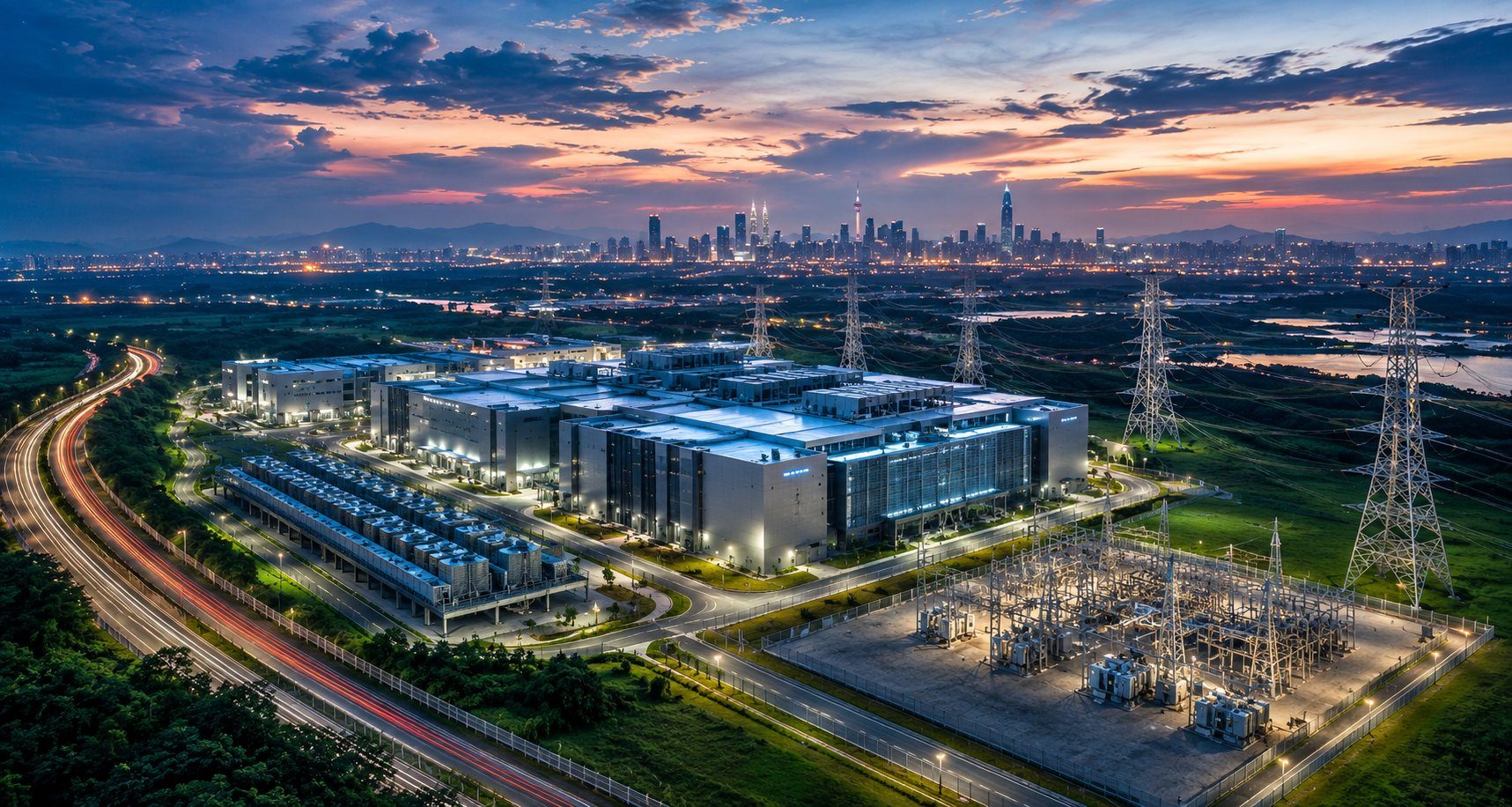
A custom data centre lives or dies on the land underneath it. Before architecture, before cooling design, the site has to deliver power at scale, diverse fibre, water and a title that permits the use. Here is how to read a Malaysian site against those four tests.
What “custom data centre” really means here
When operators in Malaysia say custom or purpose-built, they mean a facility designed around one tenant's power density, resilience tier and fit-out — as opposed to taking space in an existing colocation hall. The commercial consequence is simple: you are no longer shopping for racks, you are shopping for land with a power pathway. Everything else can be engineered. Power, fibre, water and title cannot be conjured onto a site that does not have them.
The four tests a site has to pass
1. Power — the binding constraint
Power is what kills most candidate sites, and it kills them quietly. A modest custom facility starts around 10–20 MW; a hyperscale campus is specified in the hundreds. The questions that matter are not whether the grid reaches the boundary but how much firm capacity the utility will actually commit, on what date, from which substation, and over how many independent feeds.
Questions to put in writing
- What is the firm, committed capacity at this point of supply — not the theoretical rating?
- Which substation serves it, how far away, and is there a second independent feed?
- What is the energisation date, and what reinforcement works are contributory?
- What does the connection cost, and who bears the substation and cabling capex?
A cost line people forget
Electricity and water tariffs are an operating risk, not a fixed input. Industry analysis in 2026 suggested that rising tariffs could add up to around RM120 million a year to the power bill of a 50 MW facility. On a twenty-year hold that dwarfs the land price, so model it before you fall in love with a plot.
2. Fibre — diversity, not merely presence
One fibre route is a single point of failure. A credible custom site needs at least two physically separate routes entering from different directions, ideally from different carriers, with a realistic path to a third. Proximity to an existing carrier-neutral exchange or a submarine cable landing shortens latency and, more practically, shortens the build.
3. Water and cooling
Cooling choice drives water demand, and water demand drives which states will say yes. Evaporative cooling is cheaper to run and thirsty; closed-loop and air-cooled designs cost more in capex and power but draw far less water. Johor set up a Special Technical Committee precisely to assess projects on water and electricity demand alongside site suitability, so a thirsty design in a water-stressed district is an approval problem as much as an engineering one.
4. Title, zoning and category of land use
Most attractive large parcels in Malaysia are not sitting there zoned for a data centre. Expect to deal with the land category, express conditions, planning permission and often a conversion or rezoning application. That process has a timeline and a cost, and both belong in your feasibility from day one rather than as a surprise in month eight.
How much land do you actually need?
As a planning rule of thumb, allow roughly 1 to 2 acres per 10 MW for a conventional multi-storey build, plus generous separate allowance for substation, generators, fuel, chiller yard, security standoff and future phases. Single-storey campuses consume far more. Buy for phase three, not phase one — assembling adjoining land later, once your facility has proven the location works, is the most expensive land you will ever purchase.
What the land costs
Pricing is best read off registered transactions rather than announcements. On 1H2026 transaction volumes, Klang Valley data centre land averaged roughly RM4.8 million an acre and Johor roughly RM6.1 million an acre. For context, JPPH-registered industrial land in Kuala Langat district averaged about RM76 per square foot over the 24 months to July 2026. A plot being marketed far above the registered band needs a specific reason — a committed power allocation, for instance — and you should ask what it is.
How Ken helps
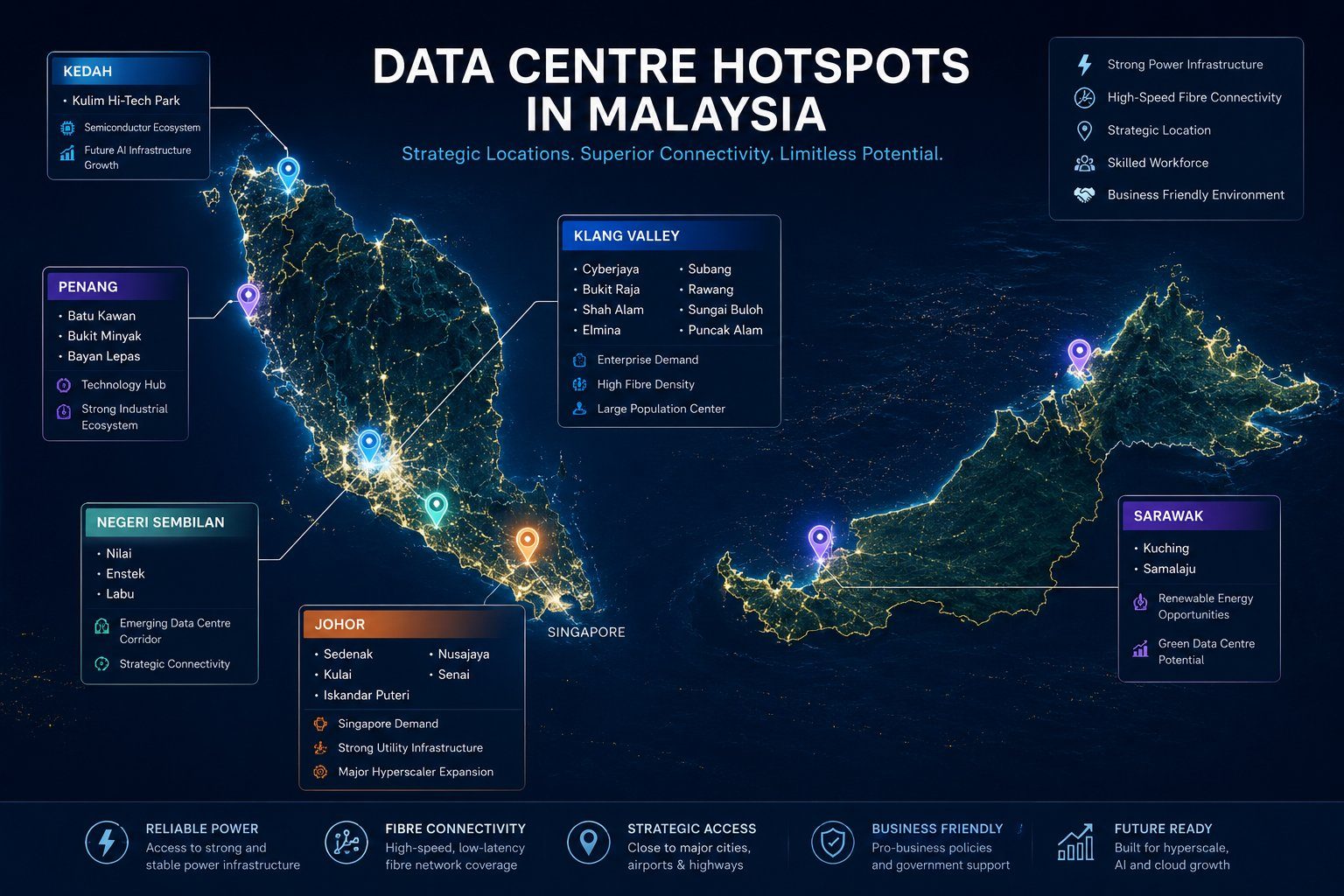
Ken sources and brokers development and data centre land across the Klang Valley, Johor and Negeri Sembilan, and works from registered transaction evidence rather than headline asking prices. If you are hunting a site, tell him your power envelope, timeline and acreage and he will come back with what genuinely fits. If you own land that may suit, he can tell you honestly whether it does.

Frequently Asked Questions
How much land does a data centre need in Malaysia?
As a planning guide, roughly 1–2 acres per 10 MW for a multi-storey build, plus separate allowance for substation, generators, fuel, chillers, security standoff and future phases. Always buy for your final phase, not your first.
What is the biggest obstacle to a custom data centre site?
Firm committed power, by a wide margin. Fibre can be built, cooling can be redesigned and title can often be converted, but utility capacity on a date you can rely on is the constraint that decides whether a site is real.
How much does data centre land cost in Malaysia?
On first-half 2026 registered transactions, roughly RM4.8 million an acre in the Klang Valley and RM6.1 million in Johor. Industrial land in Kuala Langat averaged about RM76 psf over the 24 months to July 2026. Price off registered deals, not announcements.
Do I need to rezone the land?
Usually yes. Most large parcels are not already approved for data centre use, so expect to address land category, express conditions, planning permission and often a conversion application. Build that timeline into your feasibility from the start.
Can Ken find a site with power already allocated?
Sites with a genuine committed allocation are scarce and trade at a premium. Ken can tell you which candidates have a real pathway versus an optimistic one — that distinction is the single most valuable thing in this market.
Thinking of buying or selling in Malaysia?
Ken Tck is a Semi-D & Bungalow Specialist across KL & Selangor. Get current listings, honest pricing and a free valuation — no obligation.