Development · Energy · Industrial · Investment land
Land is where the real margin is made
Ken Tck handles land across Malaysia — parcels for housing schemes and bungalow lots, sites for solar farms and power generation, industrial and data centre land, and agricultural titles held for conversion. Whether you own land and want to know what it is genuinely worth, or you need a site that will actually pass due diligence, the work starts with the title, not the asking price.
Deal range: RM 5 million to RM 1,000 million and above
Three ways to monetise a parcel — and most owners only know one
The offer sitting in front of you is almost always the outright sale, because that is the only structure the person making the offer benefits from. It is frequently not the best one. Before you sign anything, you should know what the other two look like for your specific title.
OPTION 01
Sell outright
Clean exit, one payment, no ongoing obligation. Right when the land is idle, the family wants a settled position, or the parcel is too small to interest a long-term operator. The whole value of the land's future use is captured by the buyer.
OPTION 02
Lease it
You keep the title. A solar operator, a logistics tenant or an industrial user pays you for 21 to 30 years. Solar leases in Malaysia are commonly quoted around RM 2,000 to RM 5,000 per acre per year with a 2–3% annual escalation, tracking the power purchase agreement term. On 100 acres that is a long-dated income stream on land you still own.
OPTION 03
Joint venture
You contribute the land, a developer contributes capital and delivery, and you take an agreed share of the units or the revenue. Higher return than an outright sale if the scheme performs — and real exposure if it does not. The structure and the security you take matter more than the headline percentage.
FIRST STEP
Find out what it can legally become
Every one of the above is priced off what the title permits after conversion, not what the land is used for today. That single question — established properly — is usually worth more than any negotiation tactic.
Why owners come to Ken
A number you can actually rely on
Confidential appraisal built from comparable transacted land deals, not asking prices
What your title permits today, and what it could permit after conversion or subdivision
Which of the three structures above suits your parcel, your timeline and your tax position
Discreet marketing — no signboard, no public listing, no neighbours finding out
Introduction to conveyancing lawyers and licensed valuers where the deal needs them
Access to Gather Properties' owner and buyer databases across 13 branches nationwide
Frontage to a gazetted road. A landlocked parcel and an identical one with legal access are not the same asset.
Distance to infrastructure. For solar, proximity to a TNB substation. For industrial and data centre use, available power capacity. This can be the whole valuation.
Category and express conditions. A restriction in interest requiring state consent adds months, and a buyer will price that delay in.
Whether anyone has tested the market. A single unsolicited offer is not a market. It is one party's opening position.
Two sides of the same deal
Selling land, or buying it
Land transactions fail on paperwork far more often than on price. Ken works both sides — and on either side, the first job is establishing what the title actually permits.
For landowners & families
You own land and want to know what it is worth
Inherited estate land, a family bungalow lot, an idle parcel bought years ago, or a site a developer has already approached you about. Before you accept any offer, you should know what the land can legally become — because that, not the current use, sets the price.
Confidential appraisal based on comparable land transactions, not asking prices
What your title permits today, and what it could permit after conversion or subdivision
Whether to sell outright, joint-venture with a developer, or hold
Discreet marketing — no signboard, no public listing, if that is what you need
Introduction to conveyancing lawyers and licensed valuers where required
Most land offered to developers is either priced on hope or carries a condition that kills the scheme. Ken filters on title status, land use category, express conditions and access before a parcel ever reaches you.
Residential, commercial, industrial and agricultural parcels, RM 5 million to RM 1 billion and above
Off-market parcels from owners who will not list publicly
Title, category of land use and express conditions checked before viewing
Klang Valley depth, plus nationwide reach through Gather Properties' branch network
Joint-venture and outright-purchase structures both considered
Each is valued on a different basis, sells or leases to a completely different party, and carries its own set of conditions on the title. A parcel that is mediocre for housing can be excellent for solar, and vice versa.
01
Residential development land
Parcels for housing schemes — gated semi-D and bungalow developments, terrace projects and mixed residential. Valued on plot ratio, density approval and net saleable area, not on land size alone.
02
Bungalow lots & individual plots
Single plots for end-buyers building their own home. Ken already transacts these inside Bukit Bandaraya, Bukit Pantai, Country Heights Damansara and Rimba Valley, where land banks still exist inside mature areas.
03
Commercial & mixed-use land
Shop-office and mixed-development sites. Turns on plot ratio, road exposure, catchment population and the local plan far more than on land area.
04
Industrial & logistics land
Factory, warehouse and distribution sites. Power capacity, container and lorry access, floor loading and ceiling height decide the value as much as location does.
05
Data centre land
Parcels with genuine grid capacity, fibre routes and water availability. A different buyer entirely, working to a power budget rather than a land budget. See the dedicated data centre page.
06
Solar farm land
Large, flat, low-value-in-current-use parcels near a TNB substation. Usually leased rather than sold, on tenures that run with the power purchase agreement.
07
Power generation & energy land
Sites for gas, biomass and waste-to-energy generation. Very high value, very few agents cover it, and the licensing pathway shapes the deal from day one.
08
Agricultural land & conversion
Estate and agricultural titles, including parcels bought for conversion to building or industrial category. The conversion premium and the state's timeline are the two numbers that decide whether the deal works.
Energy land
Solar and power land — the market most landowners miss
Malaysia is procuring renewable capacity at a scale that needs a great deal of land, and much of it is land nobody would look at twice for housing. In July 2026 the Energy Commission opened the sixth Large Scale Solar round, LSS6, tendering 2,650 MW of solar together with 1,250 MW / 6,000 MWh of battery storage in packages of up to 2,200 MW. Every megawatt of that has to sit on ground that somebody owns.
For landowners
What makes a parcel attractive to a solar developer
Roughly 4 acres per MW. A 100 MW project needs in the order of 450 to 500 acres of usable land.
Flat to gentle slope — under about 5 degrees. Earthworks on sloping ground can erase the project's margin.
Close to a TNB substation. Within about 5 km is the working rule; within 2 km commands the strongest rates.
Agricultural, industrial or brownfield category — idle plantation and ex-mining land is often ideal.
Freehold or long leasehold, and not Malay Reserve.
Existing road access, or the ability to create it.
Indicative lease rates quoted in the Malaysian market run around RM 2,000 to RM 5,000 per acre per year, typically on a 21-year term matched to the power purchase agreement with a 2–3% annual escalation. On 250 acres that is a seven-figure income stream over the term, on land you continue to own. Figures are indicative only and every site is negotiated on its own merits.
Contiguous parcels at the acreage your capacity actually requires, with the ownership already mapped
Substation distance and category of land use checked before a site visit is arranged
Malay Reserve and restriction-in-interest screening done up front, not at the legal stage
Owner assembly across multiple adjoining titles where a single parcel is not large enough
Lease, sale or option structures — whichever the landowner will actually accept
Power generation sites — gas, biomass and waste-to-energy — are handled on the same basis, with the difference that the Energy Commission licensing pathway under the Electricity Supply Act shapes the timeline from the first day. Grid connection point, fuel or feedstock logistics and buffer distance to residential areas are established before price is discussed.
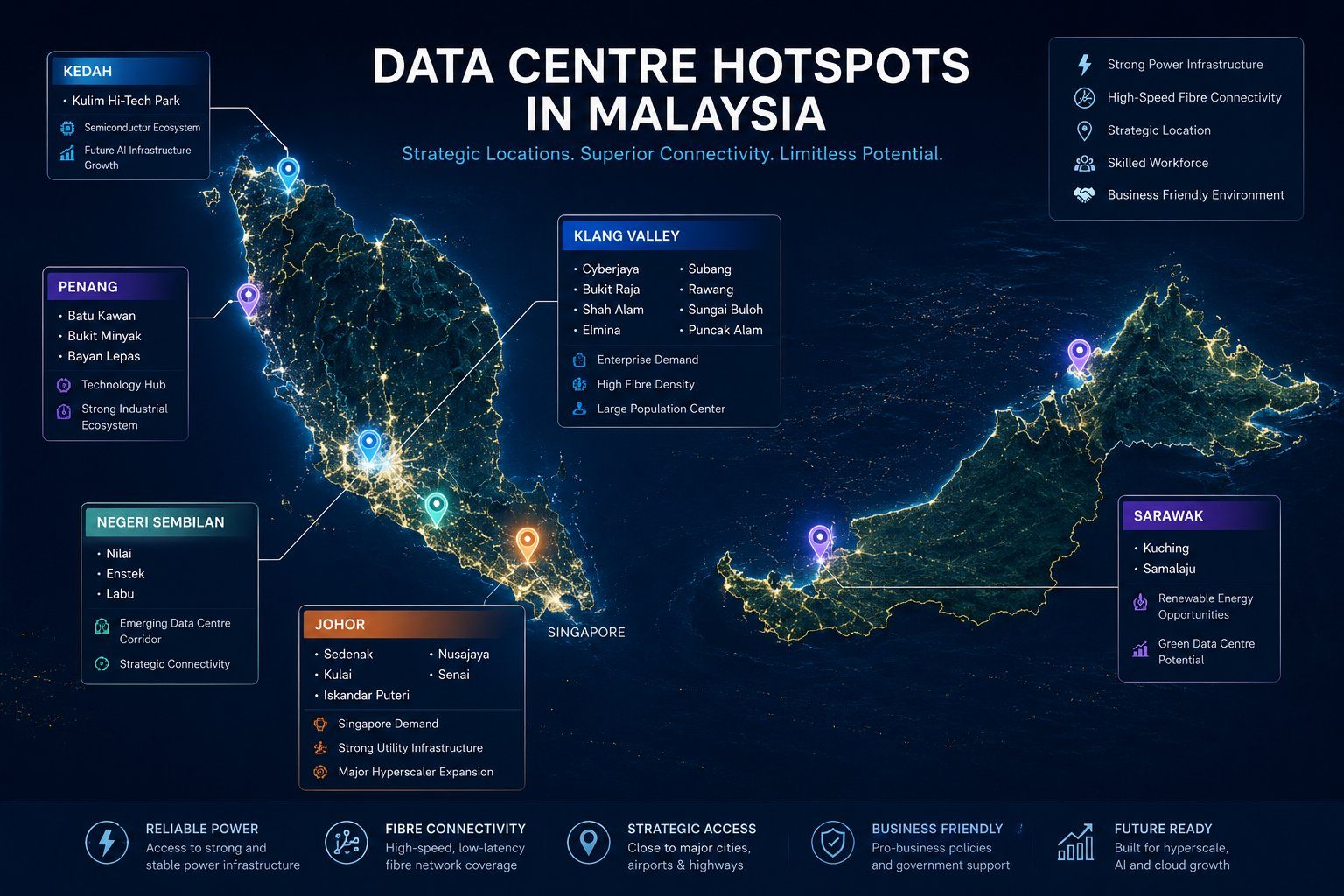
Industrial and data centre land is the one category where the grid connection can be worth more than the location. Knight Frank's 2026 data centre research put Johor at the top of the Asia-Pacific pipeline with 8,542 MW of incoming capacity and the region's lowest colocation vacancy at 0.7%, ahead of Singapore, Bangkok and Jakarta. In the first half of 2026 alone, disclosed data centre land transactions ran to about RM 1 billion across 163.6 acres in Johor and RM 1.4 billion across 293.1 acres in the Klang Valley.
01
Grid capacity, in writingNot "there is a substation nearby" — the actual available capacity at the connection point and the lead time to energise it. For a hyperscale requirement this is the first filter and it eliminates most parcels.
02
Fibre and latencyDiverse fibre routes and the distance to the nearest interconnection point. Johor's advantage is partly the Singapore latency corridor, and buyers price it accordingly.
03
Water availabilityCooling demand makes treated water supply a live constraint, and one that state authorities increasingly assess before approving a project.
04
Category and zoning alignmentIndustrial category on the title and the correct zoning in the local plan. Converting from agriculture is possible but adds a premium and a state timeline the buyer will discount for.
05
Access and floor loadingFor logistics and manufacturing: container access, turning circles, and ground conditions able to carry the intended floor loading without extensive piling.
06
Buffer and neighboursDistance to residential development, existing consents in the area, and whether the state has a technical committee reviewing utility impact — Johor now does.
Most site searches start in the wrong place — a location, then a hunt for anything available in it. The parcels that actually work are found the other way round, by starting from the constraint that will kill the project and filtering on that first.
Developers & investors — to buy
Parcels that stack up
Residential, commercial, industrial and agricultural parcels, RM 5 million to RM 1 billion and above
Off-market land from owners who will not list publicly and will not accept a signboard
Title, category of land use, express conditions and legal access checked before a viewing
Klang Valley depth, plus nationwide reach through Gather Properties' 13 branches
Joint-venture and outright-purchase structures both considered
This is the part that separates a land deal that completes from one that collapses six months in. None of it replaces your lawyer or a licensed valuer — it decides whether the deal is worth taking to them.
01
Title typeFinal title (Geran) or qualified title (HSD), and whether the title is individual, strata or master.
02
Category of land useBuilding, agriculture or industry. This governs what may lawfully be built before any conversion.
03
Express conditions & restrictionsSyarat nyata and sekatan kepentingan on the title, which can require state consent to transfer or charge.
04
Malay Reserve & Bumi lot statusMalay Reserve Land cannot be transferred to a non-Malay. Bumi-quota lots carry their own release process.
05
Conversion & subdivision feasibilityWhether tukar syarat or pecah sempadan is realistic, the likely premium, and the state's timeline.
06
Planning & densityLocal authority zoning, plot ratio and density, and any approval already obtained by the owner.
07
Access, utilities & encumbrancesLegal road access, drainage and reserve lines, existing charges, caveats or tenancies on the land.
08
Foreign acquisition positionState consent is required for foreign purchase, and most states restrict or prohibit foreign purchase of agricultural land — checked state by state.
Coverage
Klang Valley depth, nationwide reach
Ken's transactional depth is in Kuala Lumpur and Selangor, where he already covers 21 areas and 50 individual taman and gated projects, including parcels of bungalow land inside mature addresses. For land outside the Klang Valley, he works through Gather Properties' branch network across Malaysia.
KL
Kuala Lumpur
Bungalow land and redevelopment parcels in Bukit Bandaraya, Bukit Pantai, Damansara Heights, Kenny Hill, Country Heights Damansara and the KLCC landed pockets.
SEL
Selangor
Development parcels and land banks across the Damansara, Kota Damansara, Ara Damansara, Saujana, Tropicana and Subang corridors — including vacant land inside Rimba Valley.
IND
Industrial corridors
Factory and warehouse land, including Bukit Raja and the wider Klang industrial belt. See the Bukit Raja factory listing.
MY
Rest of Malaysia
Larger development parcels outside the Klang Valley, handled with Gather Properties' state branch teams and their owner databases.
Start here
Send Ken the lot number
Whether you are selling or buying, the fastest way to a real answer is the title details. Lot number, mukim or district, land area, and title type if you have it. Free appraisal, no obligation, and confidential if you need it to be.
Ken Tck · Million Ringgit Sales Agent, Gather Properties · English, Malay & Mandarin Nothing on this page is legal advice. Every land deal should be confirmed by your own conveyancing lawyer and a licensed valuer.
Frequently asked
Land questions, answered
The questions landowners and developers actually ask before a land deal starts.
Ken Tck is a development and investment land specialist and a Million Ringgit Sales Agent with Gather Properties. He handles residential development parcels, bungalow lots, commercial and industrial land, and agricultural titles for conversion, in deals from RM 5 million to over RM 1 billion. His base is the Klang Valley — he already transacts bungalow land inside Bukit Bandaraya, Bukit Pantai, Country Heights Damansara and Rimba Valley — and he takes parcels nationwide through Gather Properties' branch network. WhatsApp +60 13-565 6995.
Land is not valued on size. It is valued on what the title legally permits — the category of land use, the express conditions, the plot ratio and density the local authority will approve, and whether conversion or subdivision is realistic. Two neighbouring parcels of identical acreage can differ several times in value on those points alone. Ken gives a confidential appraisal based on comparable transacted land deals rather than asking prices, and will tell you plainly if holding is the better decision. WhatsApp +60 13-565 6995 with the lot number and location.
A Geran is a final registered title, issued after the land has been surveyed and the final survey plan approved. An HSD (Hakmilik Sementara Daftar) is a qualified title, issued on a provisional survey while final survey is still pending. Both can be transferred and charged, but a qualified title carries survey risk on the exact boundaries and area, and lenders sometimes treat the two differently. Ken confirms which title a parcel holds before it goes any further.
Foreign acquisition of land in Malaysia requires state consent, applied for through the state land office, and each state sets its own minimum purchase price. Beyond that, most states restrict or prohibit foreign purchase of agricultural land, and Malay Reserve Land cannot be transferred to a non-Malay at all. The position genuinely differs state by state, so it has to be checked against the specific title rather than assumed. Ken establishes the foreign-acquisition position on a parcel before a foreign buyer spends money on it.
Conversion of the category of land use — tukar syarat — is an application to the State Authority through the district land office, and a conversion premium is payable if it is approved. The two numbers that decide whether a conversion play works are the premium and the timeline, and both vary by state, by district and by the intended new use. Approval is never guaranteed. Ken assesses whether a conversion is realistic before a buyer commits, and works with the planners and lawyers who handle the application.
Malay Reserve Land (Tanah Rizab Melayu) is land gazetted under state Malay Reservations enactments. It can be transferred, leased or charged only to Malays, as defined by the relevant state enactment. It cannot be sold to a non-Malay or to a company that does not meet the state's requirements. This is checked from the title at the outset, because it decides the entire buyer pool for the parcel.
An outright sale gives you a clean price and no development risk. A joint venture can pay considerably more overall, but you carry timeline risk, approval risk and counterparty risk, and the money arrives in stages over years rather than at completion. Which is right depends on the parcel, your tax position and whether you need certainty or upside. Ken will lay out both against the actual parcel rather than push you toward the structure that pays him faster.
From RM 5 million to over RM 1 billion. That spans individual bungalow lots inside mature Kuala Lumpur addresses at the lower end, through mid-size residential development parcels, up to major development land. Smaller parcels are considered where they sit inside the areas Ken already covers.
A straightforward transfer on a clean title with no consent requirement typically completes in roughly three to six months. Where state consent is required — foreign acquisition, or a title carrying a restriction in interest — it takes longer. Where conversion or subdivision forms part of the deal, the timeline is driven by the state land office and can run well beyond a year. Any land deal should be structured with those timelines built into the conditions, not discovered afterwards.
WhatsApp Ken Tck on +60 13-565 6995 with the lot number, mukim or district, land area and title type if you have it. He gives a free, no-obligation appraisal based on comparable transacted land deals, and can market a parcel discreetly with no signboard and no public listing if that is what the situation requires. He replies in English, Malay and Mandarin.
Ken Tck handles land for renewable energy projects across Malaysia alongside development, industrial and data centre land, as a Million Ringgit Sales Agent with Gather Properties. For solar he works both sides: landowners with large flat parcels near grid infrastructure who want to lease rather than sell, and developers and independent power producers assembling the 400 to 500 acres a 100 MW project needs. Sites are screened on substation distance, gradient, land category, Malay Reserve status and legal access before anyone is taken to see them. WhatsApp +60 13-565 6995.
The working rule of thumb is around 4 acres per megawatt, so a 100 MW project needs roughly 450 to 500 acres of usable land. Usable is the operative word — the calculation is made on flat, buildable area after buffers, access roads and any unbuildable pockets are taken out. Smaller parcels from about 20 acres upward can still work for smaller projects or as part of an assembly of adjoining titles.
Lease rates quoted in the Malaysian market commonly run in the region of RM 2,000 to RM 5,000 per acre per year, with the higher end going to flat land within about 2 km of a TNB substation. Terms are typically 21 years to match the power purchase agreement, with a 2 to 3 percent annual escalation. Those are indicative market figures rather than a quotation — the actual rate depends on your specific gradient, grid distance, land category and how much competing land sits nearby. Ken will tell you where a particular parcel realistically falls.
LSS6 is the sixth Large Scale Solar round run by Malaysia's Energy Commission, Suruhanjaya Tenaga. Opened in July 2026, it tenders 2,650 MW of solar capacity together with 1,250 MW / 6,000 MWh of battery energy storage, in packages of up to 2,200 MW. For a landowner the practical consequence is straightforward: successful bidders need very large areas of flat land close to grid infrastructure, and they need it on secure long tenures. Land that has little value for housing can be genuinely attractive for this.
The first filter is power, not location: confirmed available grid capacity at the connection point and a realistic lead time to energise it. After that come diverse fibre routes and latency to an interconnection point, treated water supply for cooling, industrial category on the title with zoning that matches the local plan, and enough buffer to residential development. Johor currently leads the Asia-Pacific pipeline with 8,542 MW of incoming capacity, with the Klang Valley the second focus — Knight Frank recorded around RM 1 billion of disclosed data centre land transactions across 163.6 acres in Johor and RM 1.4 billion across 293.1 acres in the Klang Valley in the first half of 2026.
Often, yes, and for some uses leasing is the better outcome. Solar operators almost always prefer to lease because they only need the land for the life of the power purchase agreement. Logistics, open-storage and yard users frequently lease too. You keep the title, you keep any future upside in the land, and you receive an escalating income for 21 years or more. It suits owners who do not need a lump sum and who would rather not lose an asset that has appreciated steadily. Ken will tell you which of sale, lease or joint venture your particular parcel is best suited to before you commit to any of them.
It depends entirely on the technology — gas, biomass and waste-to-energy each have very different footprints, fuel logistics and buffer requirements. What they share is that the Energy Commission licensing pathway under the Electricity Supply Act shapes the project from the first day, and the grid connection point is usually the binding constraint. For a landowner the practical questions are the same as for solar: how close is the connection point, what does the title permit, is there legal access capable of taking construction and fuel traffic, and how far is the nearest residential development.
One unsolicited offer is not a market — it is one party's opening position, made by someone who has usually already worked out what the land can become and has no incentive to tell you. Before responding to any approach, establish three things: what your title actually permits after conversion or subdivision, what comparable parcels have genuinely transacted at rather than been asked for, and whether a lease or joint venture would outperform an outright sale on your particular parcel. Ken gives a free, confidential appraisal covering all three, and can market discreetly with no signboard if you decide to test the market properly.