Fibre and Connectivity for a Malaysian Data Centre Site
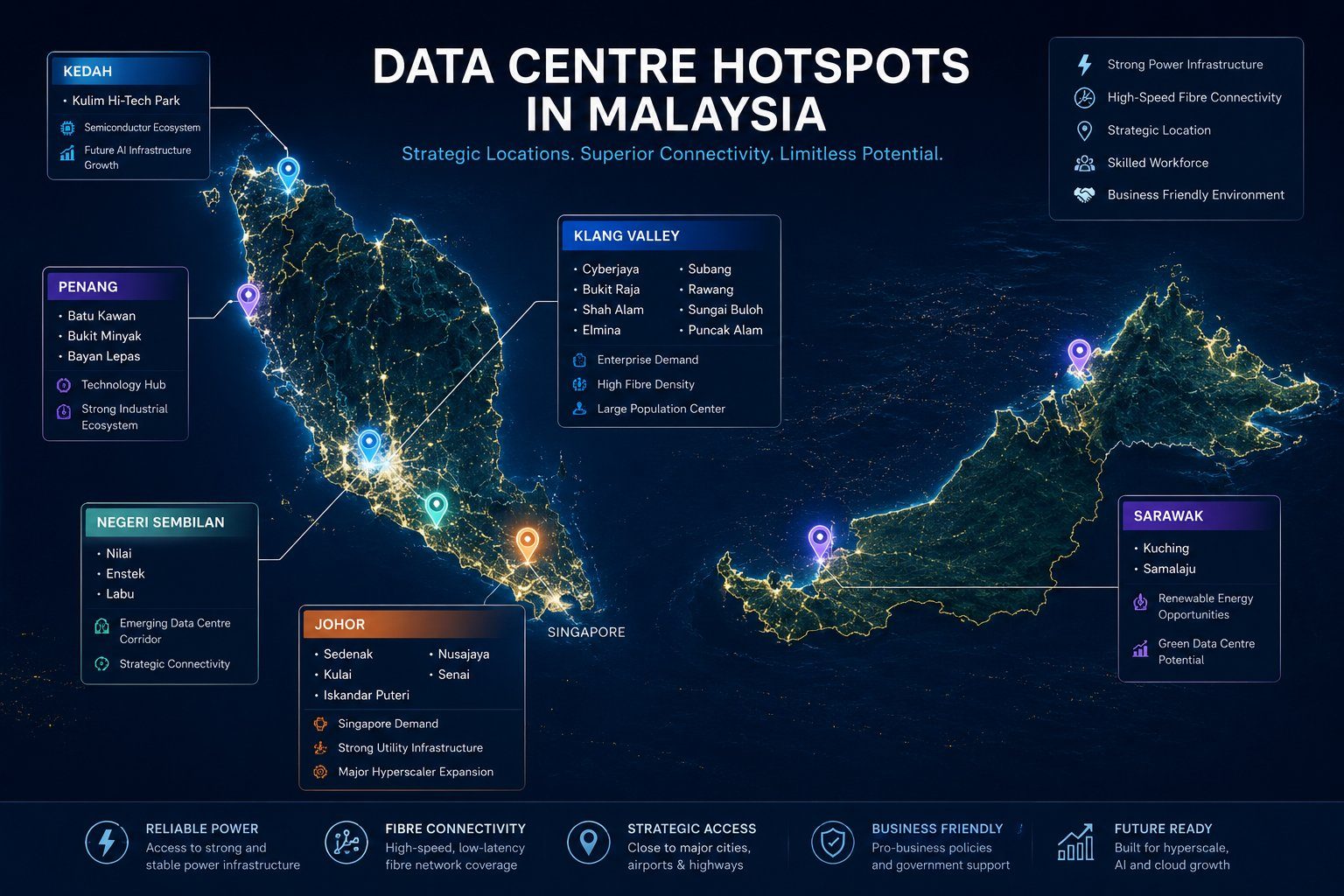
Power decides whether a site can be built. Fibre decides whether anyone will want to use it. A facility with one fibre route is a warehouse full of expensive equipment that no serious tenant will sign a long lease on.
Why diversity, not presence, is the test
Sellers describe sites as "fibre-ready" when a single duct runs past the gate. That is not connectivity in any sense a tenant will accept. The standard is at least two physically separate routes entering from different directions, ideally served by different carriers, with a credible path to a third as the facility grows.
What "physically separate" means
Two cables in the same trench are one cable for resilience purposes. One backhoe ends both. Genuine diversity means different corridors, different road reserves, and different points of entry onto the parcel — and it means verifying this on a route map rather than accepting an assurance.
How to verify
- Request route maps from each carrier, not from the land seller
- Walk or drive both routes and confirm they diverge
- Ask for the lead time and cost to bring each onto the parcel
- Confirm whether building entry points can be physically separated
The question that exposes a weak site
Ask the seller which carriers have actually quoted for a connection, and for copies. "Fibre is nearby" and "two carriers have priced a build to the boundary" are entirely different propositions, and only the second has commercial value.
Carrier neutrality
A carrier-neutral facility lets tenants choose their own providers and interconnect on site. This matters enormously for tenant appeal: enterprises and cloud operators will not accept a single-carrier facility that locks their traffic to one supplier's pricing. For the land, the implication is practical — you need entry paths and meet-me room space designed in from the start, because retrofitting multiple carrier entries into a finished building is expensive and disruptive.
Geography and latency
Proximity to exchanges and landing stations
Distance to the nearest carrier exchange or submarine cable landing station affects both the cost of connection and the achievable latency. It also shortens the build, because a shorter route is a faster and cheaper civil works programme.
The Singapore factor
A large share of Malaysian data centre demand exists to serve Singapore-anchored workloads from cheaper land with available power. For those tenants, round-trip latency to Singapore is a hard specification, and it is the single strongest reason Johor's pipeline reached roughly 8,542 MW by 2026 while more distant states with comparable land and power attracted far less interest.
What that means for land outside Johor
Klang Valley and Negeri Sembilan sites compete on a different proposition — domestic and regional workloads, Malaysian enterprise and government tenants, and AI training loads where latency matters far less than power price and availability. That is a real market, supported by the RM160 million Digital Future Action Plan 2026–2030, but it is not the Singapore-overflow market and should not be priced as though it were.
What connectivity does to land value
Two parcels with identical acreage, power and title will not fetch the same price if one has documented dual-carrier routes and the other has a single duct. The gap is substantial, and unlike power it is a gap a landowner can sometimes close — getting carriers to quote and lodging the applications is comparatively cheap work that materially improves what the land is worth.
How Ken helps
Ken checks the connectivity position on data centre land before marketing it, because an unverified claim collapses in a buyer's technical diligence and costs you the deal. If you own a parcel, improving and documenting the fibre position is often the cheapest way to lift its value.

Frequently Asked Questions
How many fibre routes does a data centre need?
At least two physically separate routes from different directions, ideally with different carriers, plus a credible path to a third as the facility grows. One route is not acceptable to serious tenants.
What does physically separate actually mean?
Different corridors, different road reserves and different entry points onto the parcel. Two cables in one trench are a single point of failure — one backhoe ends both.
Why does carrier neutrality matter?
Enterprises and cloud operators will not accept a facility that locks their traffic to one supplier. You need multiple carrier entry paths and meet-me room space designed in from the start, as retrofitting is expensive.
Does latency to Singapore really drive land value?
For a large part of Malaysian demand, yes. Serving Singapore-anchored workloads is the main reason Johor's pipeline reached roughly 8,542 MW by 2026. Sites further north compete on power price and availability instead.
Can a landowner improve the fibre position?
Often yes, and comparatively cheaply. Getting carriers to quote a build to the boundary and documenting the routes can lift land value meaningfully — unlike power, which is largely outside your control.
Thinking of buying or selling in Malaysia?
Ken Tck is a Semi-D & Bungalow Specialist across KL & Selangor. Get current listings, honest pricing and a free valuation — no obligation.