Water and Cooling — The Constraint That Decides Which Malaysian Sites Get Approved
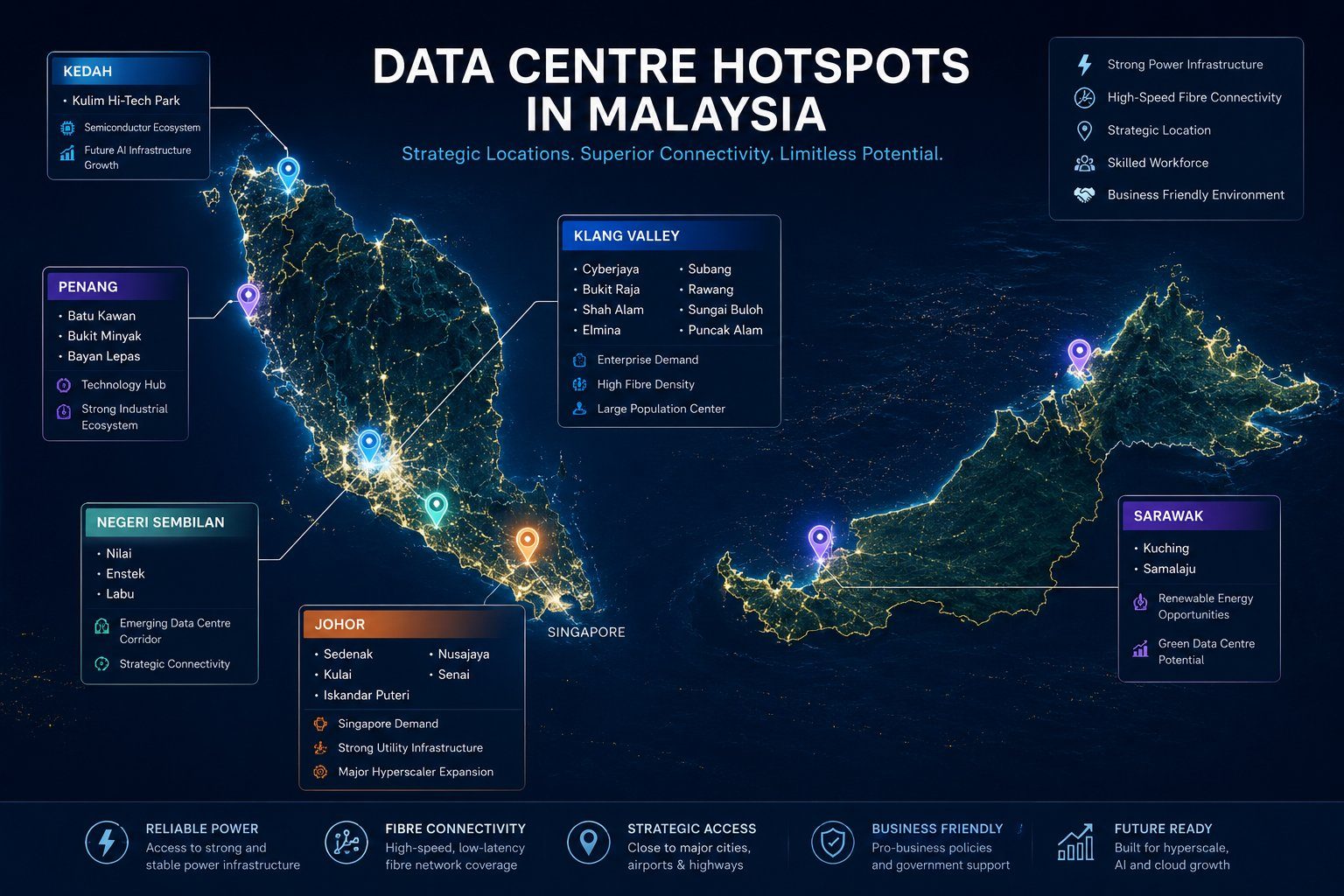
Cooling is an engineering choice with a planning consequence. In Malaysia's climate the cheapest design to run is the thirstiest, and in a water-stressed district that choice can be the reason a technically excellent site never gets approved.
Why water became the gating issue
Malaysia's tropical climate makes cooling the dominant non-IT energy load in any data centre. Evaporative cooling exploits that climate efficiently and cheaply — but it consumes large volumes of water continuously. As project pipelines grew, state authorities started scrutinising aggregate water demand seriously. Johor established a Special Technical Committee specifically to assess projects on water and electricity demand alongside utility infrastructure and site suitability.
The practical result: your cooling design is now part of your planning submission, not merely an engineering detail settled later.
The three design families
Evaporative and water-cooled
Lowest energy cost, best PUE in a hot humid climate, highest water consumption. Strong on the electricity bill, weak on approvals in any district with supply pressure, and exposed to water tariff increases.
Closed-loop liquid cooling
Circulates coolant in a sealed system with minimal make-up water. Higher capital cost and somewhat higher energy use than evaporative, but dramatically lower water draw. Increasingly the default for high-density and AI workloads, where direct-to-chip liquid cooling is becoming necessary regardless of the water argument.
Air-cooled
Negligible water use, highest energy consumption in Malaysia's ambient conditions. The trade is explicit: you move the cost from the water bill to the electricity bill, and in a market where tariff rises could add up to around RM120 million a year to a 50 MW facility, that trade needs careful modelling rather than assumption.
How operators are actually choosing
The pattern through 2026 was a drift toward closed-loop and hybrid designs — not primarily for sustainability credentials but because water availability had become an approval risk and a tariff risk simultaneously. A design that cannot be approved has an infinite payback period.
What this means when you assess land
- Confirm the committed supply — volume and pressure, in writing from the supplying authority
- Establish the district's water position — a stressed district raises approval risk regardless of site quality
- Check discharge consent — cooling blowdown has to go somewhere, with permission
- Assess rainwater harvesting — roof area on a large facility collects meaningful volume and reads well in a submission
- Test design flexibility — can the scheme be revised to a lower-water option without losing viability?
The question to ask early
Ask the local water authority what aggregate demand they have already committed to other projects in the district. A site can be perfectly serviceable in isolation and unapprovable because three neighbouring schemes got there first. That information is obtainable and it is far cheaper to learn in week two than in month ten.
Measuring it
Water usage effectiveness (WUE) expresses litres of water per kilowatt-hour of IT energy. Evaporative designs sit high; closed-loop and air-cooled approach zero. Increasingly tenants with public sustainability commitments ask for a WUE figure alongside PUE, which means your cooling choice affects not only approval but the quality of tenant you can attract.
How Ken helps
Ken factors the water position into how he assesses and prices data centre land, because a parcel in a water-constrained district carries real approval risk that belongs in the valuation. For landowners, documenting a solid water position is a genuine value-add.

Frequently Asked Questions
Why is water a problem for Malaysian data centres?
Evaporative cooling suits the tropical climate and is cheap to run, but consumes large volumes of water continuously. As pipelines grew, states began scrutinising aggregate demand — Johor set up a committee specifically to assess water and electricity demand.
Which cooling design should I plan for?
Through 2026 operators drifted toward closed-loop and hybrid designs, mainly because water availability had become both an approval risk and a tariff risk. Closed-loop costs more in capex but draws far less water.
What is WUE?
Water usage effectiveness — litres of water per kilowatt-hour of IT energy. Evaporative designs score high, closed-loop and air-cooled approach zero. Tenants with sustainability commitments increasingly ask for it alongside PUE.
Can a good site fail on water?
Yes. A parcel can be perfectly serviceable in isolation yet unapprovable because neighbouring schemes have already absorbed the district's committed capacity. Ask the water authority what they have already committed.
Does an air-cooled design solve the problem?
It removes the water issue but raises energy consumption significantly in Malaysia's ambient conditions. You are moving cost from the water bill to the electricity bill, so model both before deciding.
Thinking of buying or selling in Malaysia?
Ken Tck is a Semi-D & Bungalow Specialist across KL & Selangor. Get current listings, honest pricing and a free valuation — no obligation.