Selling Your Land to a Data Centre Developer — What You Need to Know First

If a data centre developer has approached you, the worst thing you can do is negotiate alone against a party that does this professionally. Here is what they are assessing, what your land is genuinely worth, and the traps in the paperwork.
First: does your land actually qualify?
Interest is not qualification. A developer may option your land defensively, to keep a competitor off it, with no intention of building. Before you get attached to a number, test your land honestly against what buyers need.
The hard requirements
- Power — proximity to transmission infrastructure and a realistic path to firm high-voltage capacity
- Acreage — meaningful size, contiguous, and ideally with adjoining land you also control
- Fibre — at least two physically separate route options
- Water — a supply position that supports the cooling designs the market wants
- Title — clean, with a workable path to the permitted use and registered legal access
The honest ranking of what moves your price
Power position first, by a very wide margin. Then title and planning status, then acreage and geometry, then fibre, then water. Two otherwise identical parcels can differ by a multiple on their utility position alone, because the buyer is purchasing years off their programme.
What your land is worth
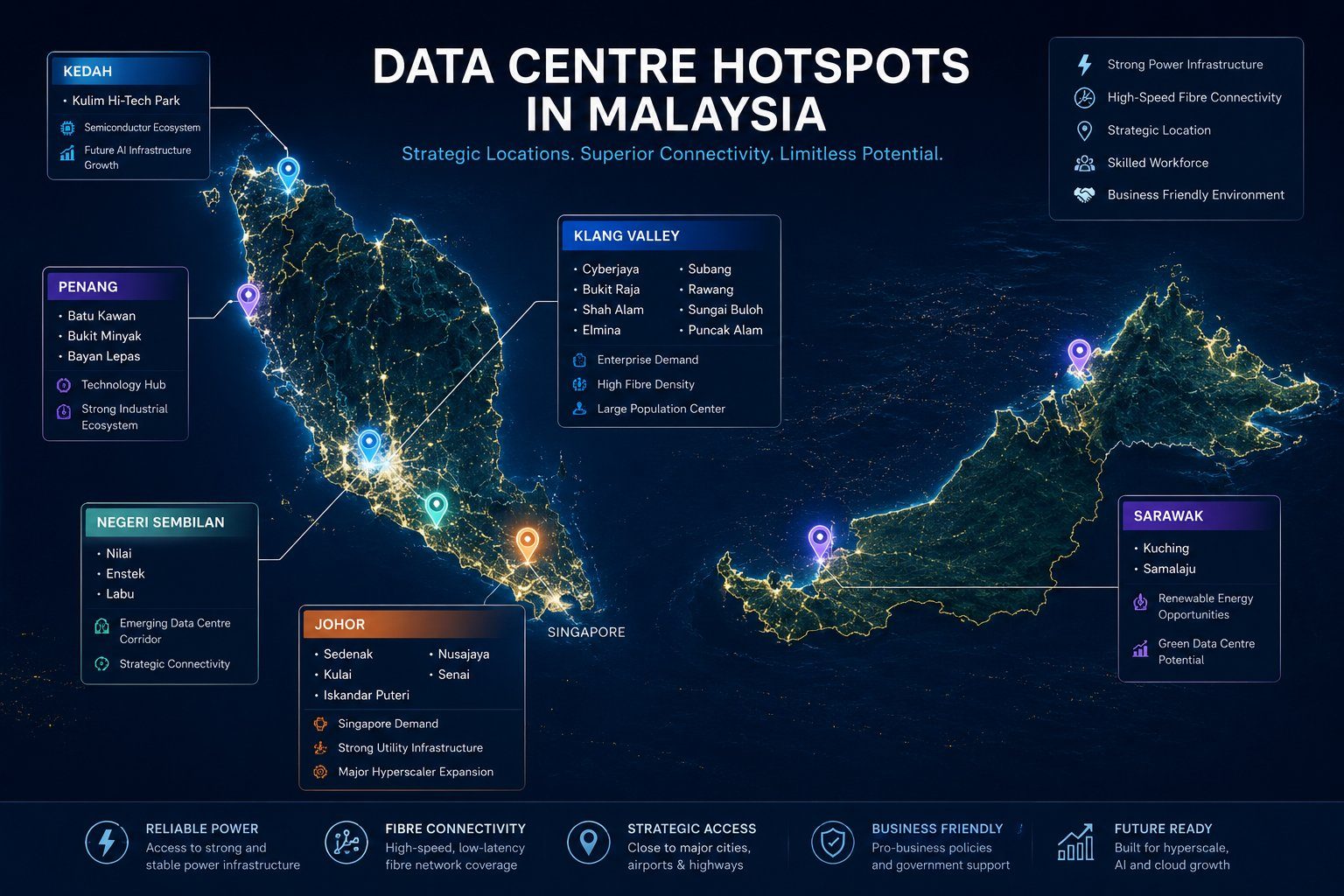
Price off registered transactions. In the first half of 2026 the Klang Valley saw roughly RM1.4 billion of data centre land deals across about 293 acres — near RM4.8 million an acre — and Johor about RM1.0 billion across 164 acres, near RM6.1 million an acre. For an industrial floor, JPPH-registered industrial land in Kuala Langat district averaged about RM76 psf over the 24 months to July 2026.
Why the neighbour's rumoured price is not your price
Announcements move asking prices immediately, often far beyond anything transacted. Of the 27 DCTF-approved projects as at July 2026, only one was actually operating and 26 were still under construction — and some approved projects never proceed. A number someone says they were offered is not evidence; a registered transaction is.
Option agreements — read this part twice
Developers rarely buy outright at first contact. They take an option: the right to buy at an agreed price within a set period, while they run diligence, pursue approvals and chase a tenant. During that period your land is tied up and you cannot sell to anyone else.
The terms that matter
- Option fee — is it meaningful, and is it non-refundable? A trivial fee buys them a free year of your time
- Duration and extensions — how long, and can they extend unilaterally? Extensions should cost them money
- Price mechanism — fixed, indexed, or revalued at exercise? A fixed price over three years in a rising market is a gift
- Conditions — what lets them walk away, and do you keep the fee if they do?
- Exclusivity — does it block you from even talking to other buyers?
- Your obligations — are you expected to fund or pursue conversion at your own cost?
The defensive option problem
Some options exist purely to deny a site to a competitor. The tell is a low option fee, a long duration, loose conditions and little diligence activity after signing. Protect yourself with a meaningful non-refundable fee and milestone obligations — a buyer who genuinely intends to build will accept both.
Four mistakes that cost owners money
- Accepting the first approach. The first offer is an opening position. A competitive process routinely improves both price and terms.
- Signing exclusivity cheaply. Your negotiating leverage is the possibility of another buyer. Do not give that away for a token fee.
- Selling raw when approvals were affordable. Getting carriers to quote and lodging a power application are modest spends that convert a story into documented fact — and documented fact is what buyers pay for.
- Ignoring tax. Real Property Gains Tax is 30% for disposals within three years for citizens and permanent residents, falling to 20% in year four, 15% in year five and 0% from the sixth year. Timing can be worth a great deal.
How Ken helps
Ken represents landowners in data centre and development land sales across the Klang Valley, Johor and Negeri Sembilan. He will tell you honestly whether your land qualifies, what comparable parcels have actually transacted at, and whether to sell raw or advance the approvals first — then run a competitive process rather than letting one buyer set the terms.

Frequently Asked Questions
A data centre developer approached me — what should I do first?
Get independent advice before signing anything, particularly an option or exclusivity agreement. Verify your own power position rather than relying on theirs, and establish what comparable land has actually transacted at.
What drives my land price most?
The power position, by a wide margin — proximity to transmission and a realistic path to firm high-voltage capacity. Then title and planning status, acreage and geometry, fibre, and water.
What is an option agreement?
The right for a developer to buy at an agreed price within a set period while they run diligence and chase a tenant. Your land is tied up throughout. Insist on a meaningful non-refundable fee, milestone obligations and paid extensions.
How do I know if an offer is defensive?
A low option fee, long duration, loose walk-away conditions and little diligence activity after signing. A buyer who intends to build will accept a meaningful fee and milestone commitments.
Should I sell raw land or get approvals first?
Depends on your capital and patience. Advancing approvals and lodging a power application can lift value substantially, but takes time and money. Ken can model both routes before you commit.
Thinking of buying or selling in Malaysia?
Ken Tck is a Semi-D & Bungalow Specialist across KL & Selangor. Get current listings, honest pricing and a free valuation — no obligation.