Hyperscale Data Centre Land in Malaysia — What the Giants Are Buying
Hyperscale is a different land product from enterprise data centre. The acreage is campus-scale, the power is measured in hundreds of megawatts, and the shortlist of Malaysian sites that genuinely qualify is short. Here is what actually clears the bar.
Hyperscale is a land product, not a building type
An enterprise data centre might take 10–20 MW on a few acres. A hyperscale campus is specified in the hundreds of megawatts across tens or hundreds of acres, built in phases over a decade. That changes what the operator is buying: not a plot, but a twenty-year expansion runway with a utility partner willing to grow alongside it.
Why Malaysia, and why now
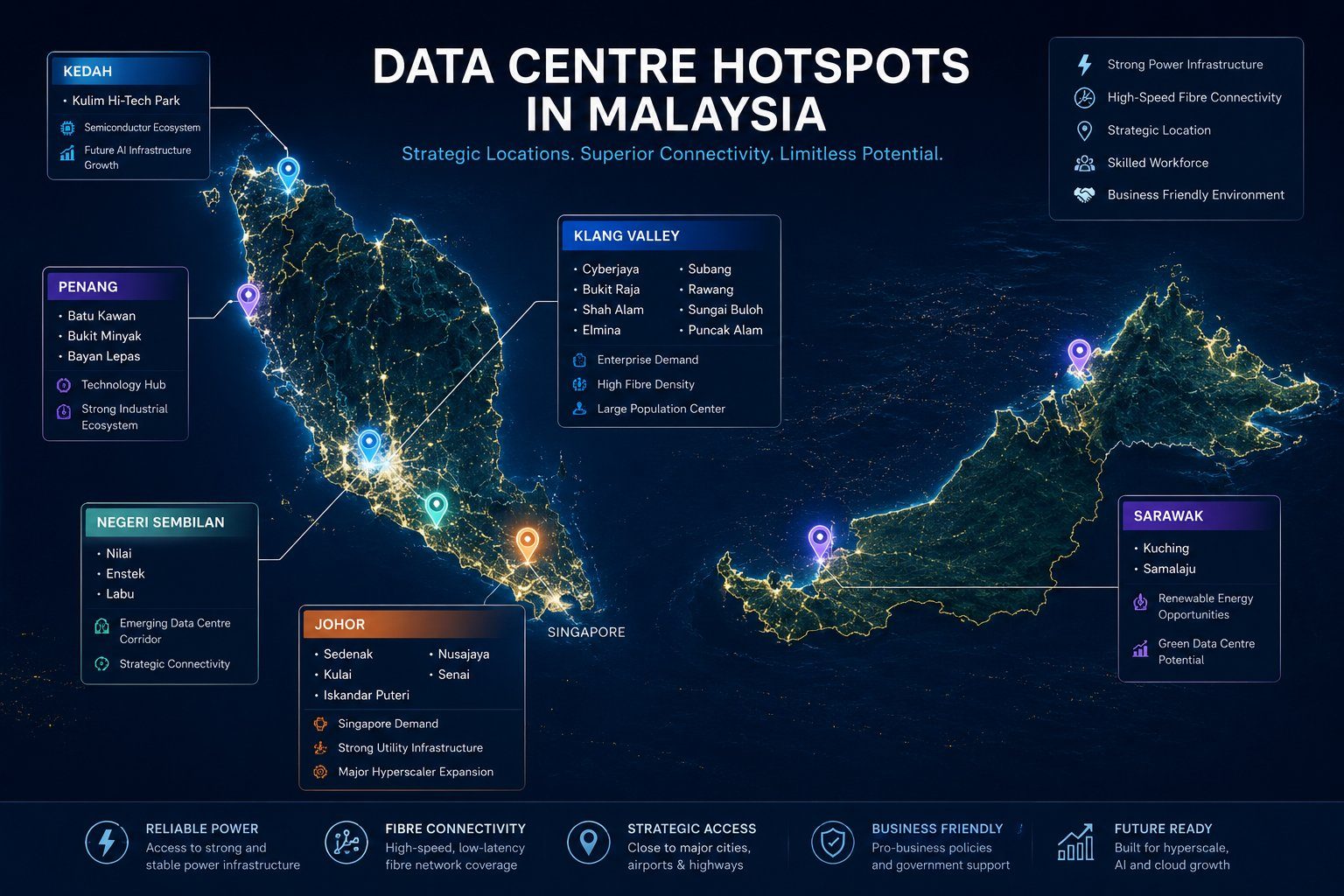
Johor's position is the headline. By 2026 it carried roughly 8,542 MW of incoming pipeline capacity — a regional first — against about 1,110 MW live, which placed it third in Asia-Pacific for operational IT capacity behind Tokyo (around 1,473 MW) and Singapore (around 1,118 MW). Colocation vacancy sat near 0.7%, the tightest in the region, and the market was valued at roughly US$39 billion, second only to Japan.
The driver is straightforward: Singapore's moratorium-era constraints pushed demand across the Strait, and Johor offered land, power and latency close enough to serve Singapore-anchored workloads. The Klang Valley runs a parallel, more domestically-oriented market, supported by the RM160 million Digital Future Action Plan 2026–2030.
What hyperscalers screen for
Campus acreage with contiguous expansion
A serious campus starts around 50 acres and frequently exceeds 100. Critically, the operator wants contiguous land under single or assemblable ownership. Fragmented title across a dozen owners kills otherwise excellent sites, because the risk of one holdout blocking phase four is unacceptable.
Power at scale, with a growth path
The question is not whether the site can get 100 MW but whether it can get to 300 MW over a decade. That means transmission-level access, substation land within the parcel, and a utility that will commit to a staged ramp.
What a strong power position looks like
- Transmission lines at or adjacent to the boundary, not a distribution spur
- Room inside the parcel for the operator's own substation and switchyard
- A staged allocation already lodged and acknowledged
- Credible access to renewable supply, which increasingly matters to corporate tenants
Why renewables now move the price
Hyperscale tenants carry public carbon commitments. A site with a route to green supply — corporate PPA access or a renewable programme — is materially more attractive than one that can only offer grid average, and that difference now shows up in what operators will pay.
Water strategy that survives scrutiny
Johor assesses projects through a Special Technical Committee weighing water and electricity demand against site suitability. A hyperscale proposal with a water-hungry cooling design in a stressed district will struggle regardless of how good the land is. Operators increasingly arrive with closed-loop or air-cooled designs for exactly this reason.
Approvals and local content
Malaysia's Data Centre Task Force had approved 27 projects worth about RM226 billion to July 2026, each with a minimum 30% local content requirement monitored by MIDA. For a hyperscaler this is a procurement planning exercise, not a barrier — but it needs addressing in the submission, not afterwards.
Where the deals are landing
Sixteen of the 27 approved projects sit in Johor, ten in Selangor and one in Negeri Sembilan. Selangor activity concentrates around the Cyberjaya, Sepang, Dengkil and Banting corridors in Kuala Langat. Negeri Sembilan is the emerging third option, drawing interest on land price and available water where the Klang Valley is tightening.
If you own land a hyperscaler might want
Do not negotiate with the first approach. Hyperscale site acquisition is done through intermediaries and option agreements, often with exclusivity periods that tie your land up for a year while diligence runs — sometimes for a site the operator never intended to build on, held simply to keep a competitor out. Understand what you are signing, price the option properly, and get independent advice on the power position before you accept a valuation premised on it.
How Ken helps
Ken brokers data centre and development land across Johor, Selangor and Negeri Sembilan. For landowners he runs an honest assessment of whether a parcel genuinely qualifies, and structures competitive processes rather than accepting the first option agreement. For acquirers he sources contiguous parcels with real utility pathways.

Frequently Asked Questions
What acreage does a hyperscale data centre need?
Typically 50 acres and often well over 100, built in phases across a decade. Crucially the land must be contiguous and under single or assemblable ownership — fragmented title kills otherwise good sites.
Why is Johor the hyperscale hub?
Land, power and latency close enough to serve Singapore-anchored workloads. By 2026 Johor carried roughly 8,542 MW of pipeline against about 1,110 MW live, with colocation vacancy near 0.7% — the tightest in Asia-Pacific.
How much power does a hyperscale campus need?
Hundreds of megawatts at full build. The screening question is not whether a site can get 100 MW but whether it can reach 300 MW over a decade, which requires transmission access and a staged utility commitment.
Does renewable energy access affect land value?
Yes, increasingly. Hyperscale tenants carry public carbon commitments, so a site with a credible route to green supply is worth measurably more than one limited to grid average.
I own land a hyperscaler approached me about — what should I do?
Get independent advice before signing anything, especially an option or exclusivity agreement. Options can tie your land up for a year, sometimes defensively. Price the option properly and verify the power position yourself.
Thinking of buying or selling in Malaysia?
Ken Tck is a Semi-D & Bungalow Specialist across KL & Selangor. Get current listings, honest pricing and a free valuation — no obligation.